
Polypropylene test bottle
 por MrCharles_3875381


Archivos imprimibles (1)
-
 stl
stlPP_test_bottle.stl
393 Ko · 48 descargas
Descripción
I wanted to experiment with printing polypropylene (PP), mainly because of several upcoming projects where its properties could be useful. While there is quite a lot of general information available about PP filaments, I struggled to find complete and reliable print settings for specific manufacturers. The default PrusaSlicer profile also felt somewhat inconsistent, so I decided to create my own test models to evaluate cooling, extrusion, speed, and overall print behavior.
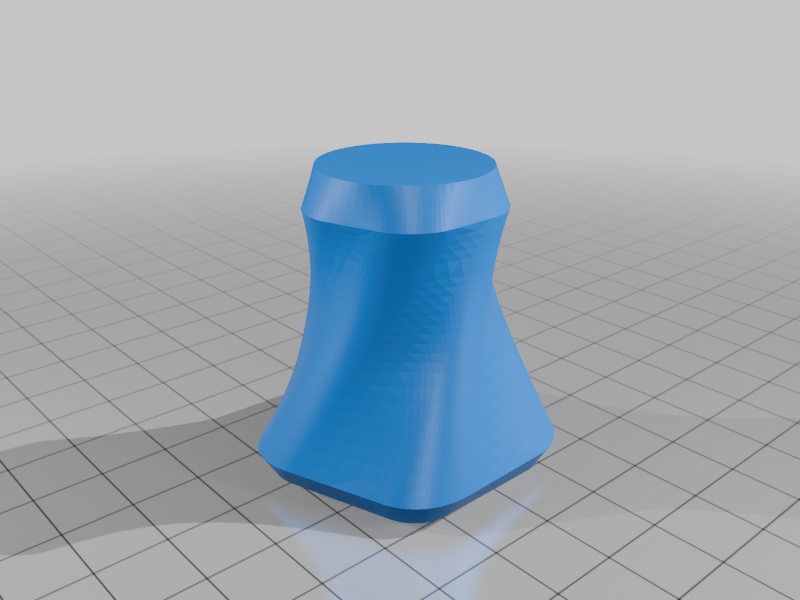
For testing, I used Verbatim PP and Sunlu PP, both of which provide very limited official guidance on print settings. I designed and printed several small objects (including these vase-like forms) to compare their performance.
The differences between the two materials were quite noticeable:
Verbatim PP is significantly more flexible, but also more difficult to work with. It tends to jam the extruder, so careful handling during loading (avoid automatic retraction) and unloading is essential. When unloading, it often forms a blob at the extruder entrance, which may require opening the idler to remove it.
It also oozes quite a bit, which makes dialing in the right settings more challenging. In my experience, it works best for simple geometries with minimal travel moves. Print speeds above ~25 mm/s resulted in noticeable quality loss, although larger and simpler designs can still be printed at higher speeds.
With this filament, the nicest Benchy I managed to print was using a 0.4 mm nozzle and 0.15 mm layer height. Interestingly, there is a noticeable difference in print quality between 0.15 mm and 0.20 mm layer heights for certain models.
On the upside, the surface finish is very smooth and "soft".
Sunlu PP, on the other hand, is stiffer and much easier to print. It allows for higher print speeds and handles more complex geometries without major issues. The surface is still smooth, although slightly less so compared to Verbatim. Bridging performance is also noticeably better compared to Verbatim PP. Overall, it feels more versatile and user-friendly.
However, i experienced slightly worse bed adhesion compared to Verbatim PP, and it produces a noticeable chemical smell after printing (Verbatim produces virtually no smell).
I’m planning to test BASF Ultrafuse PP as well, especially since BASF provides well-documented print settings, which should make the process more predictable.
I’ve also uploaded my configuration profiles in case anyone wants to try them. With these settings, the printed containers turned out watertight — I tested them with boiling water, ethylene, and isopropyl alcohol (IPA).
You can scale the model as needed; in its current size, the bottle has a volume of approximately 25 ml.
I used a 0.6 mm high-flow nozzle on a Prusa CORE One with a PP build plate.
If you have better settings or additional tips for printing PP, I’d really appreciate your feedback. Hopefully, this comparison helps others working with the same material. It took me half spool of material to be satisfied with settings.
Pictures of benchy are just to show the difference between those 2 filaments.